

Beach Wheelchairs, Pool Access and the Vacation Amenities Nobody Talks About
DeBug Mobility Products | Accessibility & Inclusive Travel
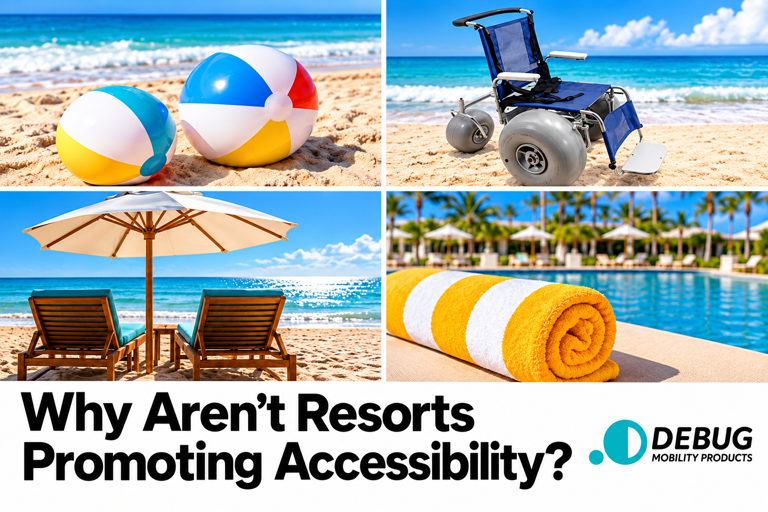
Resort accessibility is an amenity, not fine print. Imagine browsing a beachfront resort’s website while planning your next vacation. Beautiful photographs showcase oceanfront cabanas, sparkling swimming pools, paddleboards, beach umbrellas, bicycles, waterfront restaurants and children’s activities. Everything is designed to help you picture yourself enjoying the experience.
Now imagine you’re a wheelchair user.
You want to know whether you can reach the beach, enjoy the pool, participate in outdoor activities or simply spend the afternoon by the water with your family. Where do you find that information?
In many cases, you’ll need to leave the resort’s beautifully presented amenities pages and search for something labeled “Accessibility,” “ADA Information” or “Special Accommodations.” Even then, you may not find the answers you’re looking for.
That raises an interesting question: Why do resorts actively promote almost every recreational amenity they offer, yet often treat accessibility as information that guests must specifically request?
Accessibility: An Amenity or a Compliance Requirement?
Resorts invest considerable resources in creating memorable guest experiences.
A beachfront resort might advertise complimentary bicycles, beach chairs, umbrellas, kayaks, paddleboards and poolside cabanas. These amenities are presented as reasons to choose that property over another.
But what about beach wheelchairs? What about aquatic wheelchairs that allow guests with mobility limitations to enjoy the water? What about accessible beach pathways, pool lifts or sloped pool entries? These features can be just as important to a guest’s vacation experience as any other recreational amenity. Yet they are frequently presented differently.
A beach umbrella is marketed as a vacation amenity. A beach wheelchair is often treated as an accessibility accommodation.
Why the distinction?
Both help guests enjoy the beach. Both contribute to the vacation experience. Both represent an investment by the property. The difference may be less about the equipment itself and more about how resorts think about accessibility.
What Our Research Found
At DeBug Mobility Products, we recently examined the publicly available websites of 25 beachfront hotels and resorts, focusing on how they communicate recreational accessibility. We weren’t simply looking for statements about ADA compliance or accessible guest rooms. We wanted to know whether properties actively promoted accessible recreation alongside their other vacation amenities.
Our preliminary review identified three general approaches:
| Approach | Properties in our initial review |
| Active accessibility promotion | Approximately 5 |
| Primarily passive disclosure or intermediate visibility | Approximately 8 |
| Little readily discoverable recreational-accessibility information | Approximately 12 |
These findings come from a preliminary review of 25 selected properties, not a scientific or nationally representative survey. Website visibility does not establish whether a property actually has or lacks accessible equipment.
Active Promotion
Some properties incorporate accessible recreation into their broader descriptions of guest amenities. Information about beach wheelchairs, accessible beach access or other recreational accommodations is relatively easy to discover. Examples from our initial review included Omni Hilton Head Oceanfront Resort, Sandcastle Hotel on the Beach in Pismo Beach and The Lodge at Gulf State Park. Their approaches weren’t identical, but they provided useful examples of making recreational accessibility more visible.
Passive Disclosure
Other properties provide accessibility information primarily through dedicated accessibility pages or accommodation statements. Our initial review identified examples of this approach at properties including Marenas Beach Resort, Costa d’Este Beach Resort & Spa and Hotel del Coronado. These properties may provide important accessibility information. The issue is where that information appears and how easily a potential guest can discover it.
Providing information is not necessarily the same as promoting an experience.
A traveler who already knows to search for accessible beach equipment may find the information. But what about someone who doesn’t know beach wheelchairs or aquatic wheelchairs exist?
That traveler may never think to ask. And that is the information gap we’re interested in understanding.
Accessible Travel Is a Significant Market
This isn’t simply a discussion about inclusivity. It is also a discussion about business. Research from the Open Doors Organization examining the travel habits and spending of American adults with disabilities reinforces an important point: travelers with disabilities represent a substantial segment of the travel market. And their travel decisions can influence spending beyond their individual reservations.
Many travelers vacation with spouses, children, relatives, friends or caregivers. When a resort cannot accommodate one member of a traveling group, the entire group may choose another destination.
Conversely, when a resort clearly communicates its accessible recreational opportunities, it can help travelers make informed decisions before booking. That represents a marketing opportunity that deserves greater attention.
Accessibility can be both an important guest service and a competitive advantage.
Where is the disconnect?
Our research identified a visibility gap, but it did not establish why individual resorts make their marketing decisions. Several possible explanations deserve consideration.
Accessibility Is Viewed Primarily Through a Compliance Lens
Hotels and resorts operate under accessibility regulations, including applicable requirements of the Americans with Disabilities Act. For example, the ADA establishes requirements for accessible swimming pool entry, with specific provisions depending on pool size, construction and other circumstances.
But regulatory compliance and recreational marketing serve different purposes. Compliance addresses legal accessibility obligations. Marketing communicates the experiences a property offers. A resort may satisfy applicable accessibility requirements without ever featuring those accommodations in its vacation advertising.
Accessibility Information May Be Managed Separately From Marketing
At many hospitality businesses, accessibility information may be handled through operations, guest services, reservations or compliance departments, while marketing teams focus on photography, recreation, dining, accommodations and destination experiences.
If accessibility is treated as an operational subject rather than a guest-experience feature, it may never become part of the property’s primary marketing message.
This is a possible organizational explanation, not a conclusion established by our website review.
Resorts May Underestimate the Demand
A resort may assume that only a small percentage of guests need accessible recreational equipment. But that overlooks older adults, people with temporary injuries, people with limited mobility and families traveling with someone who needs additional assistance. It also overlooks the fact that accessible recreational equipment may help determine whether an entire family can participate in an activity together.
Resorts May Be Uncertain About What They Can Promise
Some properties may hesitate to advertise accessibility features because equipment availability, staffing, beach conditions or individual guest needs can vary. Those concerns are legitimate. A beach wheelchair may require advance reservations. A pool lift must be maintained and operational. A beach route may be affected by environmental conditions.
However, uncertainty doesn’t have to prevent communication. It simply means the information should be accurate. A resort can explain what equipment is available, how guests can request it and what limitations may apply. Clear information is better than leaving guests to guess.
The Difference Between Access and Participation
Consider two descriptions of the same beachfront resort.
Description A: “Beach wheelchairs are available upon request. Please contact guest services.”
Description B: “Enjoy the beach together. Our resort offers beach wheelchairs to help guests with mobility limitations experience the sand and shoreline. Contact guest services to learn about availability and reservations.”
Both communicate that beach wheelchairs are available. But the second description helps a potential guest imagine participating in the experience.
That difference matters.
Accessibility is not simply about entering a building, reaching a swimming pool or getting across the sand. It is about participating in the activities that make a vacation memorable. For a wheelchair user, access to the beach may mean spending an afternoon with grandchildren, watching the sunset with a spouse or enjoying a family photograph at the shoreline. Those are the experiences resorts are selling to everyone else.
Why shouldn’t accessible recreation be part of that same message?
Pool Accessibility Deserves More Visibility, Too
The same question applies to swimming pools.
Resort websites frequently feature spectacular photographs of infinity pools, lazy rivers, children’s splash areas and poolside lounges. Yet information about accessible pool entry may be difficult to find. For guests with mobility limitations, knowing whether a pool has a lift or sloped entry can be essential to planning a vacation.
The ADA establishes specific accessible-entry requirements for covered swimming pools, although the requirements vary according to the facility and circumstances. An aquatic wheelchair is not itself a substitute for an ADA-required accessible means of pool entry. However, aquatic wheelchairs can provide additional options for guests who need mobility assistance within appropriate aquatic environments.
Rather than simply stating that a pool is accessible, resorts could provide meaningful details about how guests can use it. That information belongs where guests are already exploring the pool’s amenities, not necessarily buried several pages away.
Accessibility Should Be Part of the Vacation Story
At DeBug Mobility Products, we’ve spent decades developing beach, aquatic and all-terrain mobility equipment. We’ve seen how access to the beach and water can change the experience for people with mobility limitations. We’ve also seen resorts, parks and recreation providers invest in equipment intended to make those experiences possible.
That investment deserves to be communicated.
A resort that provides beach wheelchairs should consider showing them in its beach amenities information. A property with accessible pool entry should explain those features alongside its pool descriptions. An accessible beach route should appear on the resort’s beach access information, not only in a general accessibility statement. When accessible recreational equipment is available, guests should be able to understand how to request it before arriving.
These are relatively straightforward communication improvements. They don’t necessarily require new equipment or major construction projects. They require a different approach to presenting the accessibility features a property already offers.
An Opportunity for Hospitality Marketing
Imagine a resort marketing campaign featuring families enjoying the beach. Children building sandcastles. Couples relaxing beneath umbrellas. Guests enjoying the pool, and a wheelchair user participating in those same experiences with family and friends. Not as a separate accessibility advertisement. Simply as part of the resort’s everyday vacation imagery. That approach communicates something powerful without requiring an elaborate explanation:
Everyone is part of the vacation experience.
It also allows resorts to reach travelers who might otherwise assume the destination cannot accommodate their needs. Accessibility information can be useful, accurate and promotional without making unrealistic promises.
The opportunity is to move beyond simply disclosing accommodations and begin communicating accessible experiences.
The Question We’d Like Resorts to Consider
Resorts already understand the value of promoting experiences. They know that photographs of beautiful beaches, swimming pools and recreational activities help potential guests imagine their vacations. They invest in amenities because those amenities contribute to guest satisfaction and help distinguish their properties. Accessible recreation deserves consideration within that same marketing strategy.
We’re not suggesting that every resort has the same accessibility features or that every destination can accommodate every need.
We’re suggesting something simpler.
If your property has invested in making recreational experiences more accessible, why not tell potential guests about it?
Don’t make travelers search through multiple pages to discover whether they can enjoy the beach. Don’t assume everyone knows accessible recreational equipment exists.
Don’t overlook accessibility as an opportunity to communicate the experiences your property makes possible.
Because ultimately, accessibility isn’t only about whether a service or amenity exists.
It’s also about whether people know it’s available.
Join the Conversation
We’d like to hear from travelers, hospitality professionals and accessibility advocates.
For travelers: Have you ever discovered that a resort offered accessible recreational equipment only after you arrived?
For resorts: Does your property actively promote accessible recreation, or is that information primarily included on an accessibility page?
At DeBug Mobility Products, we believe that accessible recreation should be part of the vacation conversation. And we believe that conversation is long overdue.